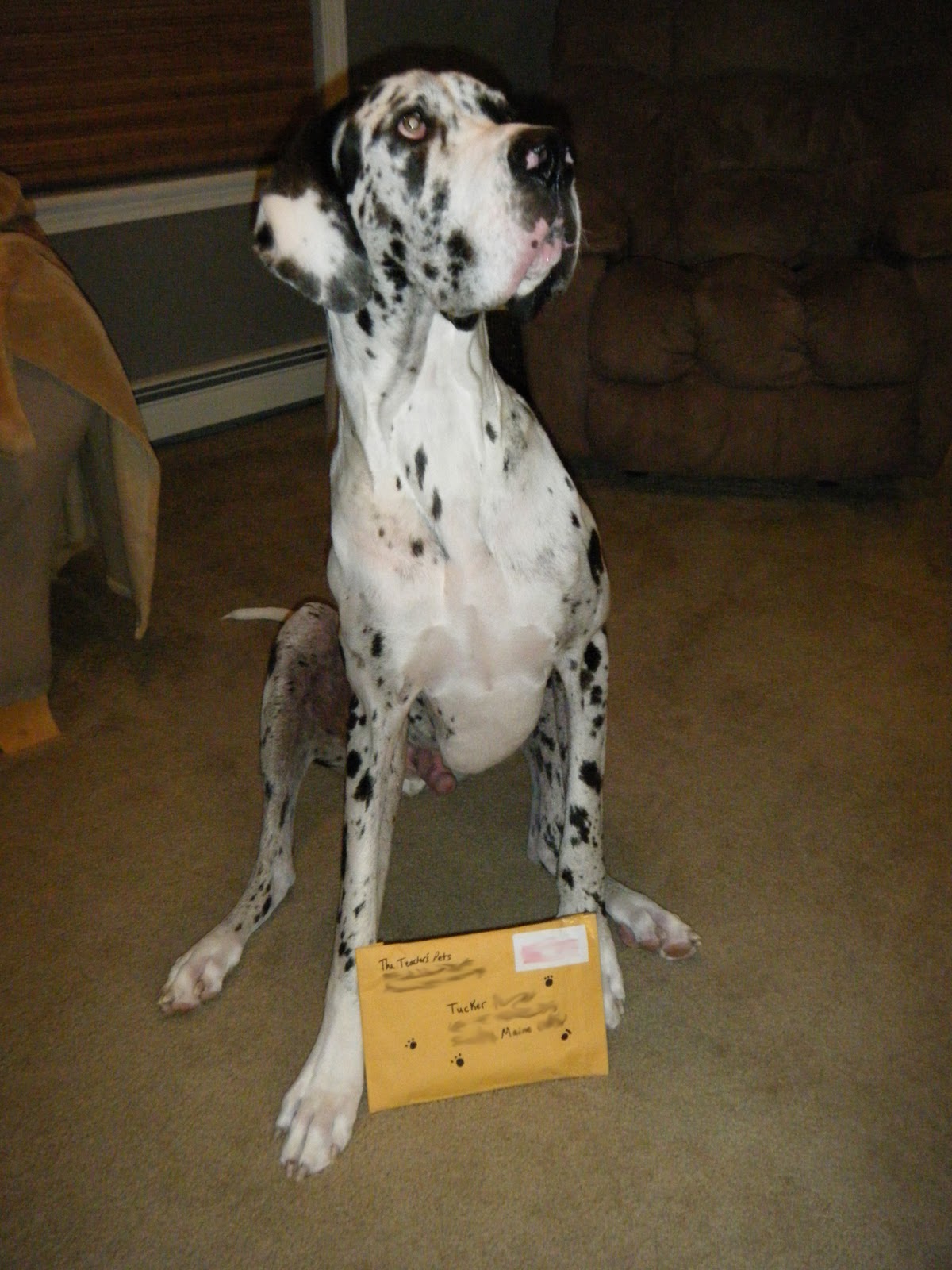
it pours, right? I have the knee ouchies. The vet says I tore the cruciate ligament in my back knee. The only good news is that he thinks I didn't rupture it. Based on the fact that I become a total wimp at the vet and get all shaky and nervous he couldn't quite feel for sure how bad the instability in my knee is. But since I am really not limping (I just turn funny and don't put weight on my leg when standing) and that I showed zero signs of pain he doesn't think it ruptured. Or I is just very strong.
Official treatment is 3 weeks of pain medicine (deremaxx and a pain shot in my butt) with close monitoring of my actions - no running, jumping, zoomies, or playing wif other doggies. I must walk at least an hour every day. I must make improvements each week and report these to Mr. Vet. If improvements are not being made it means x-ray & surgery. I have not had an x-ray yet because it is very scary to put big doggies under anesthesia. So, if I needs an x-ray I'll get the surgery too. Mr. Vet and the hoomans don't want me to have to go under twice. The real statistics are if the tear is under 50% it can heal on it's own (it very well may tear again though). Mr. vet thinks there is a 20% chance that I will needs the surgery.
How is I suppose to enjoy the Holidays if I can't do zoomies?
Note from Momma: Tucker doesn't think anything is wrong with him. He hurt his leg doing major zoomies in the snow on Thanksgiving and was limping. He showed no sign of pain when when being poked and prodded so we gave it some time. It's common for him to pull his back thigh muscle, he's done it four times in 3 years. This time the limping was better in 2 days, he continues to try to run, but when standing you can see he is putting all his weight on his other leg. Tucker's vet likes to veer on the side of caution if the pets are not showing discomfort. I like that about him. There is a strong possibility that this will heal without surgery and we are hoping we can keep him calm enough so that it will. We just need to prevent the zoomies, keep him on leash, walk him to make him use his knee correctly, and prevent him from chasing Vader. He is already putting weight back on the leg after 4 days of anti-inflammatory meds. Fingers are crossed for our boy. Also, thank you all for your kind words about Ellie. We miss her dearly.
Showing posts with label sad face. Show all posts
Friday, December 16, 2011
Tuesday, June 21, 2011
Walkies at the Ocean Edge
This past week we took a little drive to a spot I has never been before for my walkie. The air smelled so good I couldn't wait to get out the car.
There was a lot to explore.... and a lot of places I couldn't go. Hmph.
And since the sun was setting......
It was important for me to model for the hoomans..... they have the cookies.
More places I couldn't go......
And since the sun was setting......
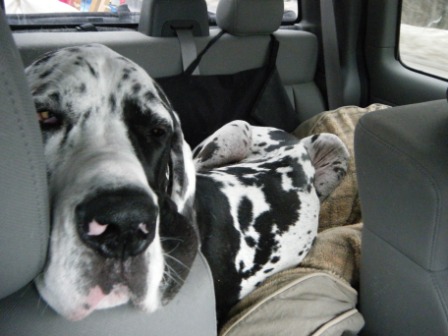
I had to leave..... I wanted to stay longer. Even the sad face didn't work, I still had to go home.
Monday, May 16, 2011
Saturday, May 14, 2011
My bubblegum nose is disappearing
I'm so depressed. My bubblegum nose is disappearing... Here is the proof!
Are you kidding me? Does this mean I can actually be a show dog now? From the AKC Breed Standard : "Nose shall be black, except in the blue Dane, where it is a dark blue-black. A black spotted nose is permitted on the harlequin; a pink colored nose is not desirable. A split nose is a disqualification. "
Oh I reads the rest of the standard too..... I is not a show dog... I've highlighted the text for some of the reasons I can not be a show dog - Plus I is tutored.
General Appearance
The Great Dane combines, in its regal appearance, dignity, strength and elegance with great size and a powerful, well-formed, smoothly muscled body. It is one of the giant working breeds, but is unique in that its general conformation must be so well balanced that it never appears clumsy, and shall move with a long reach and powerful drive. It is always a unit-the Apollo of dogs. A Great Dane must be spirited, courageous, never timid; always friendly and dependable. This physical and mental combination is the characteristic which gives the Great Dane the majesty possessed by no other breed. It is particularly true of this breed that there is an impression of great masculinity in dogs, as compared to an impression of femininity in bitches. Lack of true Dane breed type, as defined in this standard, is a serious fault.
Size, Proportion, Substance
The male should appear more massive throughout than the bitch, with larger frame and heavier bone. In the ratio between length and height, the Great Dane should be square. In bitches, a somewhat longer body is permissible, providing she is well proportioned to her height. Coarseness or lack of substance are equally undesirable. The male shall not be less than 30 inches at the shoulders, but it is preferable that he be 32 inches or more, providing he is well proportioned to his height. The female shall not be less than 28 inches at the shoulders, but it is preferable that she be 30 inches or more, providing she is well proportioned to her height. Danes under minimum height must be disqualified.
Head
The head shall be rectangular, long, distinguished, expressive, finely chiseled, especially below the eyes. Seen from the side, the Dane’s forehead must be sharply set off from the bridge of the nose, (a strongly pronounced stop). The plane of the skull and the plane of the muzzle must be straight and parallel to one another. The skull plane under and to the inner point of the eye must slope without any bony protuberance in a smooth line to a full square jaw with a deep muzzle (fluttering lips are undesirable). The masculinity of the male is very pronounced in structural appearance of the head. The bitch’s head is more delicately formed. Seen from the top, the skull should have parallel sides and the bridge of the nose should be as broad as possible. The cheek muscles should not be prominent. The length from the tip of the nose to the center of the stop should be equal to the length from the center of the stop to the rear of the slightly developed occiput. The head should be angular from all sides and should have flat planes with dimensions in proportion to the size of the Dane. Whiskers may be trimmed or left natural. Eyes shall be medium size, deep set, and dark, with a lively intelligent expression. The eyelids are almond-shaped and relatively tight, with well developed brows. Haws and mongolian eyes are serious faults. In harlequins, the eyes should be dark; light colored eyes, eyes of different colors and walleyes are permitted but not desirable. Ears shall be high set, medium in size and of moderate thickness, folded forward close to the cheek. The top line of the folded ear should be level with the skull. If cropped, the ear length is in proportion to the size of the head and the ears are carried uniformly erect. Nose shall be black, except in the blue Dane, where it is a dark blue-black. A black spotted nose is permitted on the harlequin; a pink colored nose is not desirable. A split nose is a disqualification. Teeth shall be strong, well developed, clean and with full dentition. The incisors of the lower jaw touch very lightly the bottoms of the inner surface of the upper incisors (scissors bite). An undershot jaw is a very serious fault. Overshot or wry bites are serious faults. Even bites, misaligned or crowded incisors are minor faults.
Neck, Topline, Body
The neck shall be firm, high set, well arched, long and muscular. From the nape, it should gradually broaden and flow smoothly into the withers. The neck underline should be clean. Withers shall slope smoothly into a short level back with a broad loin. The chest shall be broad, deep and well muscled. The forechest should be well developed without a pronounced sternum. The brisket extends to the elbow, with well sprung ribs. The body underline should be tightly muscled with a well-defined tuck-up.
The croup should be broad and very slightly sloping. The tail should be set high and smoothly into the croup, but not quite level with the back, a continuation of the spine. The tail should be broad at the base, tapering uniformly down to the hock joint. At rest, the tail should fall straight. When excited or running, it may curve slightly, but never above the level of the back. A ring or hooked tail is a serious fault. A docked tail is a disqualification.
Forequarters
The forequarters, viewed from the side, shall be strong and muscular. The shoulder blade must be strong and sloping, forming, as near as possible, a right angle in its articulation with the upper arm. A line from the upper tip of the shoulder to the back of the elbow joint should be perpendicular. The ligaments and muscles holding the shoulder blade to the rib cage must be well developed, firm and securely attached to prevent loose shoulders. The shoulder blade and the upper arm should be the same length. The elbow should be one-half the distance from the withers to the ground. The strong pasterns should slope slightly. The feet should be round and compact with well-arched toes, neither toeing in, toeing out, nor rolling to the inside or outside. The nails should be short, strong and as dark as possible, except that they may be lighter in harlequins. Dewclaws may or may not be removed.
Hindquarters
The hindquarters shall be strong, broad, muscular and well angulated, with well let down hocks. Seen from the rear, the hock joints appear to be perfectly straight, turned neither toward the inside nor toward the outside. The rear feet should be round and compact, with well-arched toes, neither toeing in nor out. The nails should be short, strong and as dark as possible, except they may be lighter in harlequins. Wolf claws are a serious fault.
Coat
The coat shall be short, thick and clean with a smooth glossy appearance.
Color, Markings and Patterns
Brindle--The base color shall be yellow gold and always brindled with strong black cross stripes in a chevron pattern. A black mask is preferred. Black should appear on the eye rims and eyebrows, and may appear on the ears and tail tip. The more intensive the base color and the more distinct and even the brindling, the more preferred will be the color. Too much or too little brindling are equally undesirable. White markings at the chest and toes, black-fronted, dirty colored brindles are not desirable.
Fawn--The color shall be yellow gold with a black mask. Black should appear on the eye rims and eyebrows, and may appear on the ears and tail tip. The deep yellow gold must always be given the preference. White markings at the chest and toes, black-fronted dirty colored fawns are not desirable.
Blue--The color shall be a pure steel blue. White markings at the chest and toes are not desirable.
Black--The color shall be a glossy black. White markings at the chest and toes are not desirable.
Harlequin– Base color shall be pure white with black torn patches irregularly and well distributed over the entire body; a pure white neck is preferred. Merle patches are normal. No patch should be so large that it appears to be a blanket.
Eligible, but less desirable, are black hairs showing through the white base coat which give a salt and pepper or dirty appearance.
Mantle--The color shall be black and white with a solid black blanket extending over the body; black skull with white muzzle; white blaze is optional; whole white collar is preferred; a white chest; white on part or whole of forelegs and hind legs; white tipped black tail. A small white marking in the blanket is acceptable, as is a break in the white collar.
Any variance in color or markings as described above shall be faulted to the extent of the deviation. Any Great Dane which does not fall within the above color classifications must be disqualified.
Gait
The gait denotes strength and power with long, easy strides resulting in no tossing, rolling or bouncing of the topline or body. The backline shall appear level and parallel to the ground. The long reach should strike the ground below the nose while the head is carried forward. The powerful rear drive should be balanced to the reach. As speed increases, there is a natural tendency for the legs to converge toward the centerline of balance beneath the body. There should be no twisting in or out at the elbow or hock joints.
Temperament
The Great Dane must be spirited, courageous, always friendly and dependable, and never timid or aggressive.
Disqualifications
Danes under minimum height.
Split nose. Docked Tail.
Are you kidding me? Does this mean I can actually be a show dog now? From the AKC Breed Standard : "Nose shall be black, except in the blue Dane, where it is a dark blue-black. A black spotted nose is permitted on the harlequin; a pink colored nose is not desirable. A split nose is a disqualification. "
Oh I reads the rest of the standard too..... I is not a show dog... I've highlighted the text for some of the reasons I can not be a show dog - Plus I is tutored.
General Appearance
The Great Dane combines, in its regal appearance, dignity, strength and elegance with great size and a powerful, well-formed, smoothly muscled body. It is one of the giant working breeds, but is unique in that its general conformation must be so well balanced that it never appears clumsy, and shall move with a long reach and powerful drive. It is always a unit-the Apollo of dogs. A Great Dane must be spirited, courageous, never timid; always friendly and dependable. This physical and mental combination is the characteristic which gives the Great Dane the majesty possessed by no other breed. It is particularly true of this breed that there is an impression of great masculinity in dogs, as compared to an impression of femininity in bitches. Lack of true Dane breed type, as defined in this standard, is a serious fault.
Size, Proportion, Substance
The male should appear more massive throughout than the bitch, with larger frame and heavier bone. In the ratio between length and height, the Great Dane should be square. In bitches, a somewhat longer body is permissible, providing she is well proportioned to her height. Coarseness or lack of substance are equally undesirable. The male shall not be less than 30 inches at the shoulders, but it is preferable that he be 32 inches or more, providing he is well proportioned to his height. The female shall not be less than 28 inches at the shoulders, but it is preferable that she be 30 inches or more, providing she is well proportioned to her height. Danes under minimum height must be disqualified.
Head
The head shall be rectangular, long, distinguished, expressive, finely chiseled, especially below the eyes. Seen from the side, the Dane’s forehead must be sharply set off from the bridge of the nose, (a strongly pronounced stop). The plane of the skull and the plane of the muzzle must be straight and parallel to one another. The skull plane under and to the inner point of the eye must slope without any bony protuberance in a smooth line to a full square jaw with a deep muzzle (fluttering lips are undesirable). The masculinity of the male is very pronounced in structural appearance of the head. The bitch’s head is more delicately formed. Seen from the top, the skull should have parallel sides and the bridge of the nose should be as broad as possible. The cheek muscles should not be prominent. The length from the tip of the nose to the center of the stop should be equal to the length from the center of the stop to the rear of the slightly developed occiput. The head should be angular from all sides and should have flat planes with dimensions in proportion to the size of the Dane. Whiskers may be trimmed or left natural. Eyes shall be medium size, deep set, and dark, with a lively intelligent expression. The eyelids are almond-shaped and relatively tight, with well developed brows. Haws and mongolian eyes are serious faults. In harlequins, the eyes should be dark; light colored eyes, eyes of different colors and walleyes are permitted but not desirable. Ears shall be high set, medium in size and of moderate thickness, folded forward close to the cheek. The top line of the folded ear should be level with the skull. If cropped, the ear length is in proportion to the size of the head and the ears are carried uniformly erect. Nose shall be black, except in the blue Dane, where it is a dark blue-black. A black spotted nose is permitted on the harlequin; a pink colored nose is not desirable. A split nose is a disqualification. Teeth shall be strong, well developed, clean and with full dentition. The incisors of the lower jaw touch very lightly the bottoms of the inner surface of the upper incisors (scissors bite). An undershot jaw is a very serious fault. Overshot or wry bites are serious faults. Even bites, misaligned or crowded incisors are minor faults.
Neck, Topline, Body
The neck shall be firm, high set, well arched, long and muscular. From the nape, it should gradually broaden and flow smoothly into the withers. The neck underline should be clean. Withers shall slope smoothly into a short level back with a broad loin. The chest shall be broad, deep and well muscled. The forechest should be well developed without a pronounced sternum. The brisket extends to the elbow, with well sprung ribs. The body underline should be tightly muscled with a well-defined tuck-up.
The croup should be broad and very slightly sloping. The tail should be set high and smoothly into the croup, but not quite level with the back, a continuation of the spine. The tail should be broad at the base, tapering uniformly down to the hock joint. At rest, the tail should fall straight. When excited or running, it may curve slightly, but never above the level of the back. A ring or hooked tail is a serious fault. A docked tail is a disqualification.
Forequarters
The forequarters, viewed from the side, shall be strong and muscular. The shoulder blade must be strong and sloping, forming, as near as possible, a right angle in its articulation with the upper arm. A line from the upper tip of the shoulder to the back of the elbow joint should be perpendicular. The ligaments and muscles holding the shoulder blade to the rib cage must be well developed, firm and securely attached to prevent loose shoulders. The shoulder blade and the upper arm should be the same length. The elbow should be one-half the distance from the withers to the ground. The strong pasterns should slope slightly. The feet should be round and compact with well-arched toes, neither toeing in, toeing out, nor rolling to the inside or outside. The nails should be short, strong and as dark as possible, except that they may be lighter in harlequins. Dewclaws may or may not be removed.
Hindquarters
The hindquarters shall be strong, broad, muscular and well angulated, with well let down hocks. Seen from the rear, the hock joints appear to be perfectly straight, turned neither toward the inside nor toward the outside. The rear feet should be round and compact, with well-arched toes, neither toeing in nor out. The nails should be short, strong and as dark as possible, except they may be lighter in harlequins. Wolf claws are a serious fault.
Coat
The coat shall be short, thick and clean with a smooth glossy appearance.
Color, Markings and Patterns
Brindle--The base color shall be yellow gold and always brindled with strong black cross stripes in a chevron pattern. A black mask is preferred. Black should appear on the eye rims and eyebrows, and may appear on the ears and tail tip. The more intensive the base color and the more distinct and even the brindling, the more preferred will be the color. Too much or too little brindling are equally undesirable. White markings at the chest and toes, black-fronted, dirty colored brindles are not desirable.
Fawn--The color shall be yellow gold with a black mask. Black should appear on the eye rims and eyebrows, and may appear on the ears and tail tip. The deep yellow gold must always be given the preference. White markings at the chest and toes, black-fronted dirty colored fawns are not desirable.
Blue--The color shall be a pure steel blue. White markings at the chest and toes are not desirable.
Black--The color shall be a glossy black. White markings at the chest and toes are not desirable.
Harlequin– Base color shall be pure white with black torn patches irregularly and well distributed over the entire body; a pure white neck is preferred. Merle patches are normal. No patch should be so large that it appears to be a blanket.
Eligible, but less desirable, are black hairs showing through the white base coat which give a salt and pepper or dirty appearance.
Mantle--The color shall be black and white with a solid black blanket extending over the body; black skull with white muzzle; white blaze is optional; whole white collar is preferred; a white chest; white on part or whole of forelegs and hind legs; white tipped black tail. A small white marking in the blanket is acceptable, as is a break in the white collar.
Any variance in color or markings as described above shall be faulted to the extent of the deviation. Any Great Dane which does not fall within the above color classifications must be disqualified.
Gait
The gait denotes strength and power with long, easy strides resulting in no tossing, rolling or bouncing of the topline or body. The backline shall appear level and parallel to the ground. The long reach should strike the ground below the nose while the head is carried forward. The powerful rear drive should be balanced to the reach. As speed increases, there is a natural tendency for the legs to converge toward the centerline of balance beneath the body. There should be no twisting in or out at the elbow or hock joints.
Temperament
The Great Dane must be spirited, courageous, always friendly and dependable, and never timid or aggressive.
Disqualifications
Danes under minimum height.
Split nose. Docked Tail.
Friday, May 6, 2011
I gots new wheels!
The car is too small.......
The truck is a little too small.....
But this is just right! Momma and Dad took my car away and gots me a Honda Pilot. I is a little grumpy that I has to sit farther from the windshield......
But now I gots headroom!
And my own cargo liner to protect the seats from drool and dirt.
The windows are pretty nice......
And I can kind of stand up if I want....
I said kinda...
Plus the best part is there is room for another doggie now.... hopefully Momma gets the hint.
Monday, April 4, 2011
A lesson in Hooman training
Yumm, Yumm, Numm, Numm
Oops I dropped it....
I can't reach it - can you get it for me Momma?
Hey HOOMAN... my bone fell!
Thank you.... geesh.. I tell you ....No help around here at all
Sunday, March 13, 2011
The Couch Thief
Meet my new foster Sister Navajo! She's my first foster sister ever and I was really excited to meet her. I like her lots but she has one MAJOR flaw.
She is a couch thief.
(in case you can't tell I is the one on the left)
Note from Momma: Tucker isn't being pushed off the couch, he simply doesn't get on it if Navajo is up there first. We are very proud of how well Tucker is behaving having another Dane in the house. He was so excited yesterday when we brought her here he did zoomies 4 times. Navi slept in her crate last night and Tucker made sure to sleep in the bed with us, which he rarely does. He doesn't appear too jealous, yet. My concern was the toys, we picked up most of the toys but Navi doesn't appear interested in them anyway. This is our first foster, we are very excited and are trying very hard not to fall in love with her too much.
Tuesday, February 1, 2011
Pressies!!!!
I gots mail! I just luvs mail.
It's from Daisy! I won her Momma's 1 year blog anniversary contest! How cool is that?Thank you so much Daisy!!!!!
*******************************************************************
Now my next package....
What the? Why in the world did you order these Momma? No toys, no treats - boots?
I took them out for a spin. Only 1 fell off at the end of our 30 minute walk, not too bad i guess. Momma says she needs to put them on tighter. I thinks she needs to just leave them at home.
See how impressed I am to have to wear boots now. The gift from Daisy was much better.
Saturday, January 8, 2011
Sometimes Being a Big Dog isn't so great
Subscribe to:
Posts (Atom)